
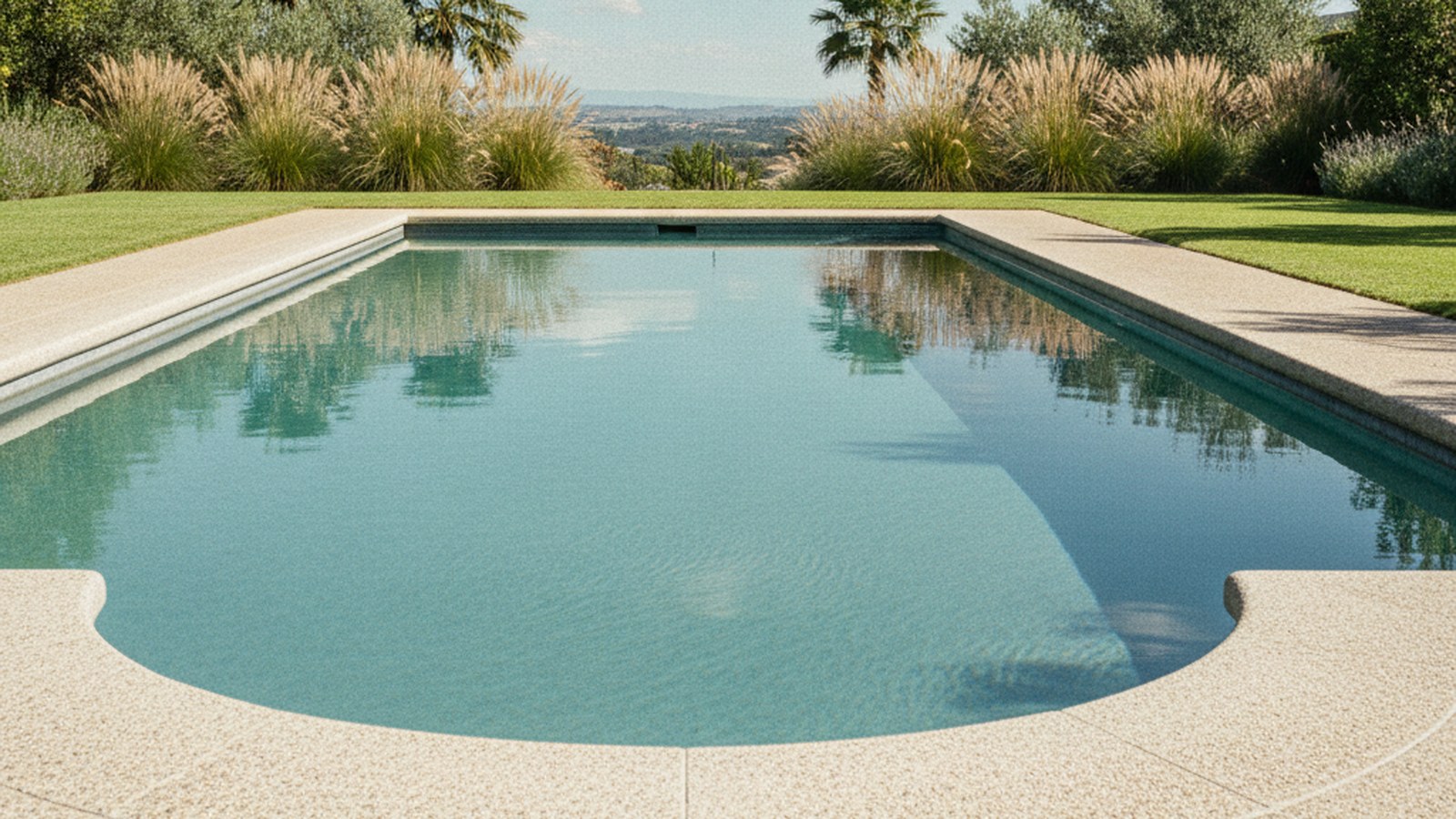
Exposed aggregate is concrete with the cement skin washed off the top, so the stone in the mix becomes the finished surface. It is laid as one continuous slab rather than as individual units, which is why it reads as seamless — no joints, no weeds, no bricks to spread apart. In Cape Town it is most often chosen for pool surrounds, patios and modern entrances.
How it is actually made
Contents
- Base and formwork. Same compacted sub-base any paving needs, plus shuttering to hold the pour and set the edges.
- Pour and level. Concrete placed, screeded and floated to the fall we set.
- Surface retarder. Sprayed on so the top few millimetres of cement stay soft while everything beneath sets hard.
- Wash off. The next day the surface is washed and brushed, taking the soft cement with it and leaving the stone standing proud.
- Cure, then seal. Sealing is not optional here — it locks the stone in and stops the surface staining.
The timing of step 4 is the whole craft. Too early and stone comes loose; too late and the retarder has lost the fight and you get a patchy, half-exposed finish that cannot be corrected without grinding.
Where it beats brick paving, and where it does not
| Exposed aggregate | Brick paving | |
|---|---|---|
| Look | Seamless, modern, no joint lines | Unit pattern, traditional |
| Weeds | None — there are no joints | Joints need occasional attention |
| Repairs | Hard to hide; a patch shows | Lift the bricks, fix, re-lay, invisible |
| Ground movement | Cracks if the ground shifts | Flexes with movement |
| Underfoot | Grippy when wet — good at a pool | Depends on the paver |
| Cost installed | R450 – R650/m² | R300 – R420/m² |
The honest summary: exposed aggregate looks better and lasts well on stable ground, and it is the wrong choice where the ground moves or where you may need to dig it up. If a service trench runs under the area, brick paving is the sensible answer. Full cost detail is on our paving prices Cape Town page.
Cape Town conditions that decide it
- Sandy Cape Flats and Blouberg ground moves. A rigid slab on poorly compacted sand will crack. Compaction and control joints matter more here than the mix does.
- Coastal salt attacks under-cured concrete. On the Atlantic seaboard and the False Bay coast, curing time and sealing are what determine whether the surface still looks right in five years.
- Summer heat is the enemy of a good pour. Concrete poured in full February sun on a windy day skins over fast and gives an uneven exposure. We work early on hot days.
- Around pools it is genuinely good — grippy wet, no joints for algae, and no bricks lifting from chlorinated splash-out.
Control joints, and why your slab has lines in it
Concrete shrinks as it cures and it will crack. Control joints are cut so it cracks in a straight line where we chose, instead of randomly across the middle. Anyone offering a large exposed aggregate area with no control joints is either not explaining it or not doing it. Spacing depends on slab thickness, and around obstacles like pool corners the joints go where the stress concentrates.
Exposed aggregate questions
How long before we can walk on it?
Foot traffic after about a week, vehicles after roughly four weeks. Concrete keeps gaining strength well past the point it feels hard.
Does it need resealing?
Yes — typically every three to five years, sooner on a pool surround taking chlorinated water daily. Resealing is cheap; letting it go and staining the stone is not.
Can you lay it over an existing slab?
Sometimes, if the slab is sound, thick enough and levels allow. Over a cracked slab, no — the crack will telegraph straight through.
What size stone?
Smaller stone gives a finer, more even look and is kinder underfoot; larger stone is more dramatic and more textured. We bring samples.
Is it slippery?
No — the exposed stone is one of the better non-slip surfaces available, which is exactly why it suits pool surrounds.
Get a price
Exposed aggregate is worth quoting properly because the ground underneath decides whether it works. We come out, look at the site and give you a written figure. See all our paving services in Cape Town.
Prefer to talk? Call 081 408 9946