
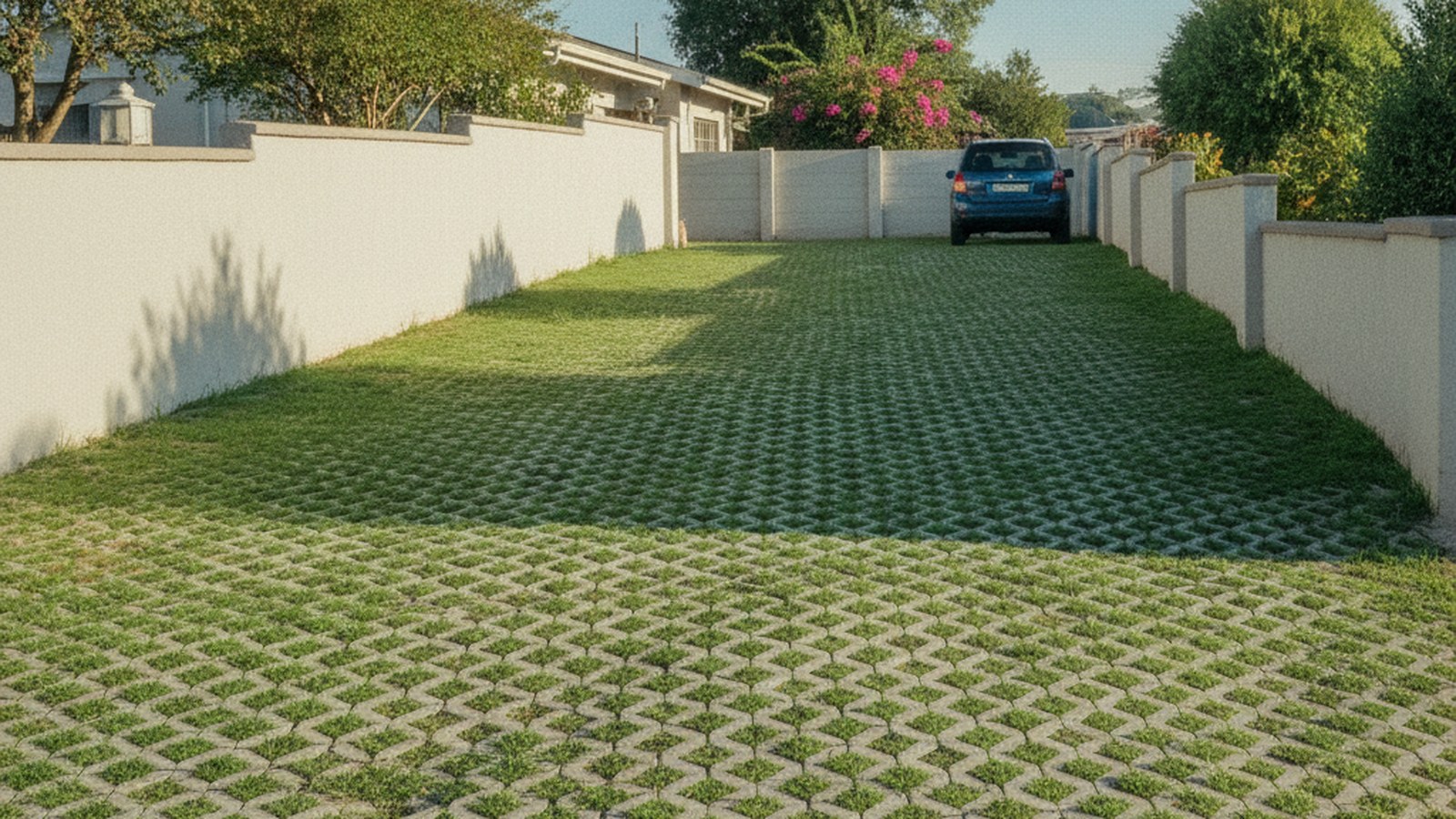
Permeable paving lets rainwater through the surface instead of running it off. Water passes through open joints or through the cells of a grass block, into a stone reservoir beneath, and then into the ground. In Cape Town it is usually chosen to solve a specific drainage problem rather than for looks — and where it fits, it is cheaper than the alternative.
The three types, and what each is for
Contents
| Type | How it looks | Best for | Installed |
|---|---|---|---|
| Grass block / open cell | Green — grass grows through the cells | Overflow parking, verges, seldom-used driveways | R350 – R500/m² |
| Gravel-filled cell | Stone, informal | Paths, farm and smallholding access | R320 – R470/m² |
| Permeable interlocking pavers | Like ordinary paving, wider joints | Driveways that must still look like driveways | R400 – R560/m² |
The third is the one most people actually want: it looks like normal brick paving from a metre away, but the joints are filled with clean angular stone instead of sand, so water goes straight down. Cost context is on our paving prices Cape Town page.
The base is completely different, and this is what people get wrong
Ordinary paving sits on compacted stone with fines in it, designed to shed water sideways. Permeable paving sits on clean, single-sized stone with the fines washed out, so the voids between the stones stay open and hold water while it soaks away.
Use normal G5 sub-base under permeable pavers and you get a surface that drains for one season and then blocks solid, because the fines migrate up and seal the voids. At that point you own an expensive driveway that puddles. If a quote for permeable paving does not specify a clean, washed, single-sized stone reservoir layer, it is not permeable paving.
The reservoir also has to be deep enough for the rainfall it will take, and on clay it needs somewhere to go — an overflow to a drain, or it simply fills and backs up.
When permeable paving is the right call in Cape Town
- Run-off has nowhere to go. A sloped southern-suburbs property where a new driveway would send winter water at the house below. Permeable paving takes the water at source and is usually cheaper than a French drain plus channel drains.
- Clay ground in the northern suburbs. Water already sits here. Permeable paving with a properly sized reservoir and an overflow buys you the surface without making the puddling worse.
- Under and near trees. Roots need water and air. Sealing the root zone under solid paving is what makes trees lift it a few seasons later.
- Overflow parking that should stay green. Grass block over a verge gives you a surface that carries a car occasionally and still reads as lawn.
Where it is the wrong call: deep loose sand that already drains perfectly well — you would be paying a premium to solve a problem you do not have. On the Cape Flats, ordinary paving on a properly compacted base is usually the better buy.
Maintenance is real, and it is one job
The failure mode for every permeable surface is clogging. Windblown sand, leaf litter and grit settle into the joints and gradually seal them. The fix is straightforward: keep the surface swept, and every couple of years have the joints vacuumed out and re-filled with clean stone. Never pressure-wash silt down into the joints, and never top up permeable joints with builder’s sand — that is the most common way a working permeable driveway is destroyed by a well-meaning owner.
Permeable paving questions
Can it take a bakkie?
Permeable interlocking pavers can, with the reservoir depth built for it. Grass block is for occasional light vehicles — daily heavy use will break the cells and kill the grass.
Does the grass survive?
In sun with occasional traffic, yes. In deep shade or under a car parked daily, no — you will end up with cells full of bare soil. Be honest about how the space is used and we will tell you which way it goes.
Does it work in a Cape winter downpour?
That is exactly what it is for. The limit is the reservoir volume and how fast the subsoil accepts water, both of which we size for the area being paved.
Is it more expensive?
Per square metre, yes — roughly R50 to R100 more than equivalent solid paving. Against the cost of drains it is often the cheaper total.
Get a drainage-aware quote
Permeable paving is worth a site visit because the answer depends on your soil and where the water currently goes. We look, and we will say plainly if ordinary paving would serve you better. See all our paving services in Cape Town.
Prefer to talk? Call 081 408 9946