
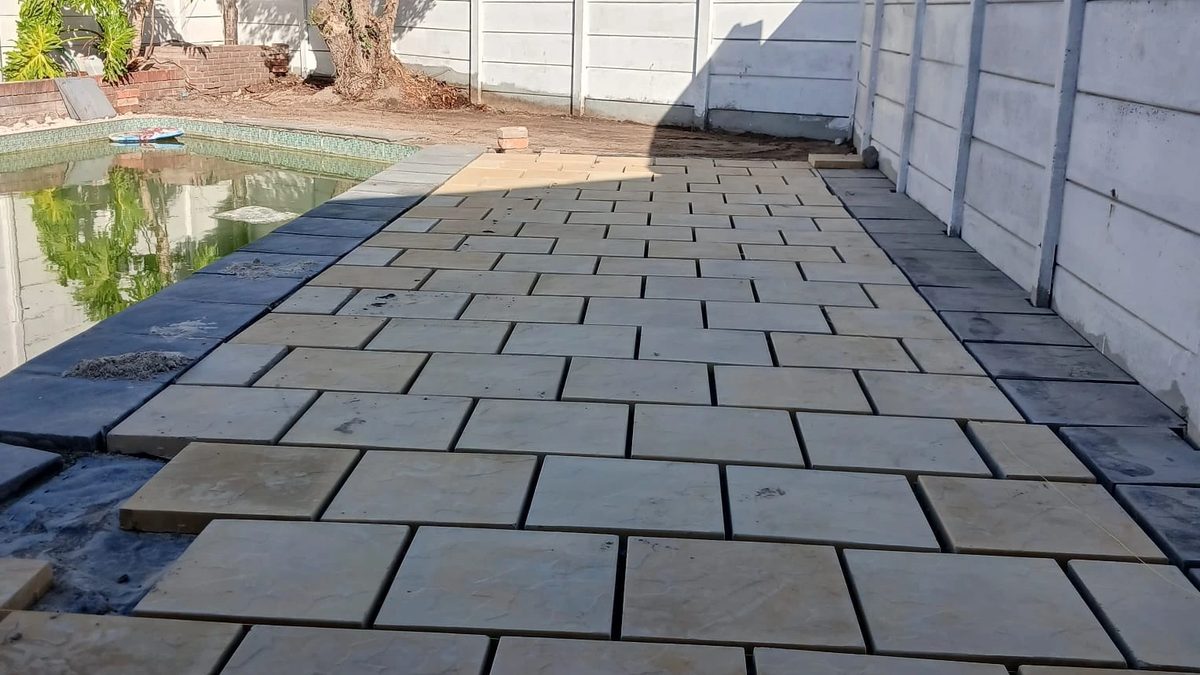
Pool paving in Cape Town is an installation job before it is a surface choice. Paving Wiz builds and re-builds pool surrounds across the metro, the Helderberg, the Winelands and the West Coast. A surround has to do three things ordinary paving does not: stay grippy when it is wet and someone is running on it, survive chlorinated splash-out, and fall away from the water so dirt and lawn clippings do not wash into the pool. Get the fall wrong and you will be cleaning the filter for years.
Fall is the decision that cannot be fixed later
Contents
- 1 Fall is the decision that cannot be fixed later
- 2 Choosing a surface you can walk on barefoot
- 3 Coping, and where the paving stops
- 4 What chlorinated water does over time
- 5 What pool paving in Cape Town has to deal with
- 6 What a pool surround costs in Cape Town
- 7 Pool paving questions
- 8 Get a price for your pool area
Water on a pool surround comes from swimmers, backwash and rain, and it carries grit with it. Paving that falls toward the pool delivers all of that straight into the water. Paving that falls away from it sends the water to a planted bed, a channel drain, or simply onto lawn.
Roughly 1 in 60 away from the coping is enough — barely visible underfoot, decisive over three metres. This is set before a single paver is laid, and it is the first thing to check on any pool paving quote. Re-laying a surround because the fall runs the wrong way costs the whole job again.
Choosing a surface you can walk on barefoot
| Surface | Wet grip | Heat underfoot | Chlorine tolerance | Installed |
|---|---|---|---|---|
| Exposed aggregate | Excellent | Moderate | Good, if sealed | R450 – R650/m² |
| Textured concrete paver | Good | Moderate | Good | R320 – R450/m² |
| Travertine / natural stone | Good | Stays coolest | Needs sealing; etches | R600 – R900/m² |
| Smooth slab | Poor when wet | Hot in summer | Good | R300 – R420/m² |
| Cobble | Good | Moderate | Good | R380 – R520/m² |
Two things people underestimate in Cape Town: dark pavers get genuinely too hot to stand on in February, and smooth slabs that look superb dry become a hazard the moment a child runs across them wet. Lighter, textured surfaces solve both. See our paving prices Cape Town page for the full cost breakdown, and exposed aggregate paving for the surface we most often recommend around water.
Coping, and where the paving stops
The coping is the edge piece capping the pool shell. The paving butts up to it, and that junction is where most pool surrounds fail. It needs a flexible joint, not rigid mortar: the pool shell and the paving move independently, seasonally and with temperature, and anything rigid between them will crack. A cracked coping joint lets water under the paving, and then the bedding washes out and the pavers start to rock.
What chlorinated water does over time
- Bleaches colour. Strongly pigmented pavers fade unevenly where splash-out lands most.
- Etches natural stone. Travertine and limestone are the most affected; sealing slows it, it does not stop it.
- Washes out joint sand. Constant wetting migrates sand out of joints, and once joints empty the pavers lose their interlock. Stabilised jointing is worth it here more than anywhere else on a property.
- Feeds algae in shade. The permanently damp shaded side of a pool grows a film that is slippery long before it looks dirty.
What pool paving in Cape Town has to deal with
The south-easter drives splash-out and leaf litter across a surround all summer, so the downwind side takes noticeably more wetting — it is worth falling the paving that way and putting the drain where the water already wants to go. On the sandy Blouberg and Table View soils, compaction around a pool matters more than usual because excavation for the shell has already disturbed the ground: paving laid on backfill that was never properly compacted will settle in a ring around the pool within a season.
What a pool surround costs in Cape Town
A pool surround is priced per square metre like any other paving, and the area is usually smaller than people expect — a walk-around strip on all four sides of a standard pool is about 40m².
| Pool area paved | Textured concrete paver | Exposed aggregate |
|---|---|---|
| Narrow strip, one or two sides (~20m²) | R6,400 – R9,000 | R9,000 – R13,000 |
| Walk-around surround (~40m²) | R12,800 – R18,000 | R18,000 – R26,000 |
| Surround plus entertainment area (~70m²) | R22,400 – R31,500 | R31,500 – R45,500 |
Two lines are specific to pool work and belong on the quote separately: the flexible coping joint, and stabilised jointing sand, which matters more here than anywhere else on a property because constant wetting washes ordinary joint sand out. Lifting an old surround first adds R60 to R120/m². The full rate breakdown is on our paving prices Cape Town page.
Pool paving questions
What is the best paving around a pool?
Exposed aggregate for grip, or a light textured concrete paver for budget. Both stay walkable when wet and neither gets as hot underfoot as a dark smooth slab. Avoid smooth slabs anywhere children run, and avoid dark colours on a north-facing surround in a Cape Town summer.
How much does paving around a pool cost?
R12,800 to R18,000 for a 40m² walk-around surround in a textured concrete paver, or R18,000 to R26,000 in exposed aggregate.
Can you pave around an existing pool?
Yes, that is most of this work. We lift what is there, correct the fall and the base, and lay the new surface up to the coping.
Will you have to drain the pool?
Normally no. We cover it to keep debris out and work around it.
What about the pump and pipework?
We locate it before we start. If pipework runs under the area to be paved, we would rather use brick paving there than a rigid slab, so a future repair means lifting bricks instead of breaking concrete.
Which surface stays coolest?
Light natural stone, then light exposed aggregate. Colour matters more than material — a pale paver in any material beats a dark one.
How long does a surround take?
Typically three to five days for a standard surround, longer if old paving has to come out or levels need correcting.
Get a price for your pool area
We come out, check the fall, look at the coping and the ground around the shell, and give you a written price per square metre. See all our paving services in Cape Town.
Prefer to talk? Call 081 408 9946