
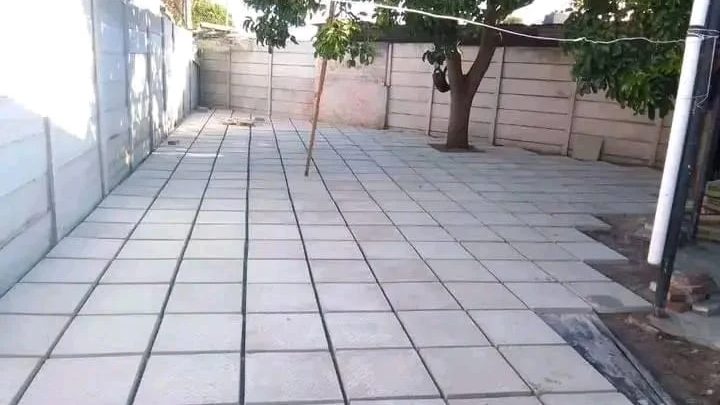
Garden paving is the paving you walk on rather than drive on — paths, stepping areas, courtyards, washing lines and the strip down the side of the house that turns to mud every winter. It is built differently from a driveway, and knowing that difference is what stops you paying driveway money for a garden path.
Garden paving costs less because it carries less
Contents
A driveway has to spread the weight of a vehicle through its layers into the ground. A garden path only ever carries people, a wheelbarrow and a lawnmower. That means:
- Shallower excavation. We dig to reach firm ground, not to fit a 150mm stone sub-base.
- 50mm pavers instead of 60mm and up. Thinner pavers cost less per square metre and are easier to cut around curves.
- A lighter base. Compacted bedding over firm subsoil is usually enough where no vehicle will ever run.
Installed garden paving typically runs R280 to R450 per square metre depending on the paver and how much cutting the shape demands. The full cost breakdown is on our paving prices Cape Town page.
One warning: if a bakkie will ever reverse onto it — even once a year to drop compost — say so before we quote. Garden build-up under a vehicle fails quickly, and rebuilding costs more than doing it properly first time.
What works where in a Cape Town garden
| Area | What we usually recommend | Why |
|---|---|---|
| Garden path | Smaller pavers or cobbles | Curves need small units; big slabs force straight lines |
| Side passage | Brick paving with fall to one side | Narrow, shaded, and usually where water collects |
| Courtyard or washing area | Slabs or large-format pavers | Fewer joints, faster to sweep, less weed growth |
| Under trees | Permeable or gapped laying | Roots need water and air; solid paving over roots lifts |
| Steep garden | Stepped paving with risers | A ramp over about 1:12 becomes unsafe when wet |
| Shady, damp corners | Textured rather than smooth surface | Smooth paving grows algae and gets slippery in winter |
The mistakes we get called out to fix
- Paving laid flat. Every paved surface needs fall — roughly 1 in 60 — or water sits on it. Flat garden paving grows moss and stains.
- Paving straight up against the house. Paving must finish at least 150mm below the damp-proof course. Laid higher, it bridges the DPC and you get rising damp in the wall.
- No edge restraint. Garden paving spreads sideways into soft soil faster than driveway paving does, because there is nothing holding it.
- Solid paving over tree roots. Roots lift it within a few seasons. Either keep clear of the root zone or use a permeable build-up.
- Smooth slabs in the shade. On the wet southern side of a Cape Town house, a polished surface is genuinely dangerous by July.
Garden paving and drainage
Paving a garden reduces the ground that can absorb rain, and that water has to go somewhere. On sandy Cape Flats and Blouberg soils it usually soaks away without trouble. On the clay-heavy northern suburbs and the sloped southern suburbs it does not, and the run-off ends up against a wall or in a neighbour’s yard.
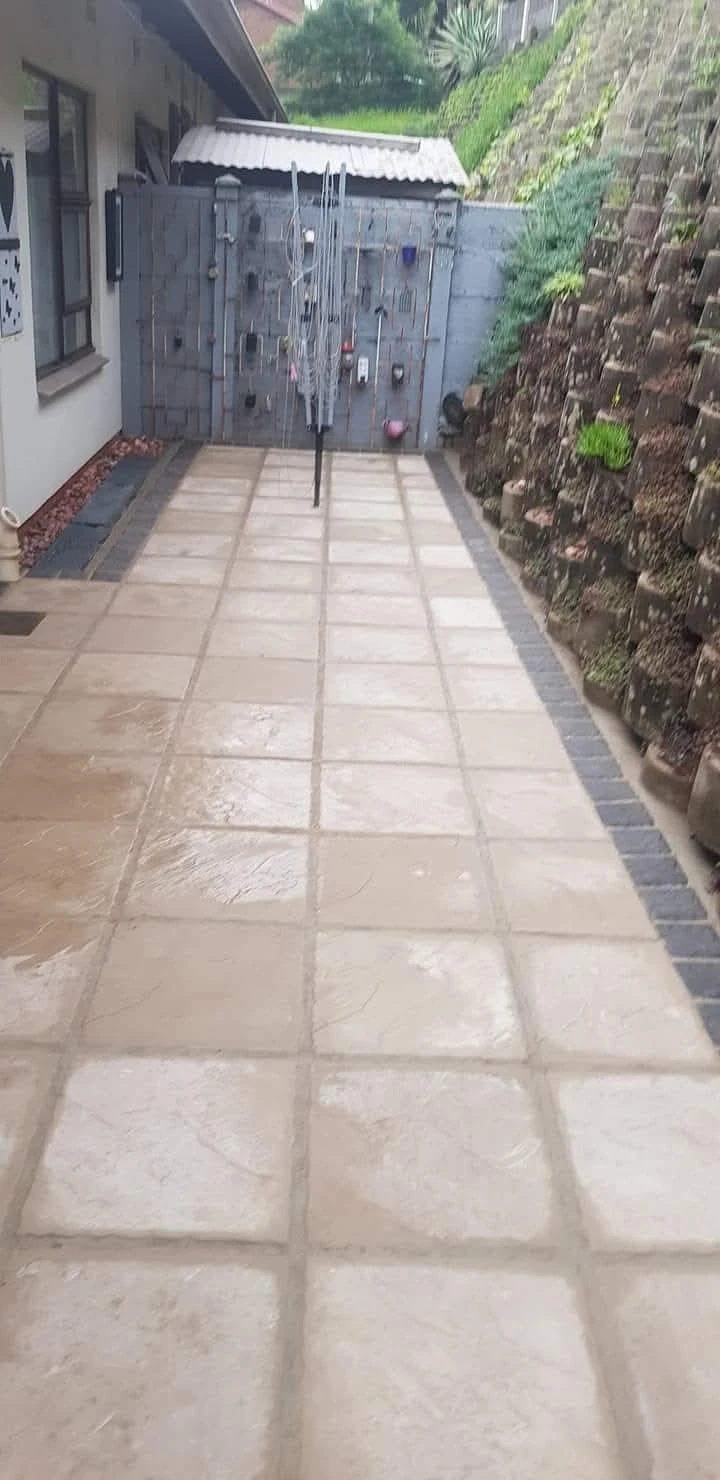
Two answers work: fall the paving toward a planted bed that can absorb it, or use permeable paving so the water goes straight through the surface. On smaller gardens the first is usually enough and costs nothing extra if it is planned before we start.
Garden paving questions
How much does a garden path cost?
A typical 10m path at 1m wide is about 10m², so R2,800 to R4,500 installed. Curves and cutting push it toward the top of that range.
Can you pave over grass?
Not directly. Grass and topsoil are organic and will rot down, taking your levels with them. It comes out first.
What is the lowest-maintenance option?
Larger units with fewer joints, laid with fall, on a surface that gets some sun. Most garden paving maintenance is weeding joints and scrubbing algae, and both are joint-and-shade problems.
Will weeds grow through?
Through a properly compacted base, rarely — most weeds germinate in windblown dirt that settles in the joints from above. Sweeping and occasional joint sand topping-up handles it.
Do you plant as well?
No. We pave, and we work around what is there. We will tell you honestly if a planned path is going to kill a tree.
Get a price for your garden
Tell us roughly what you want paved and what is on the ground now. We come out, measure it, check the fall and give you a written figure per square metre. See all our paving services in Cape Town.
Prefer to talk? Call 081 408 9946