
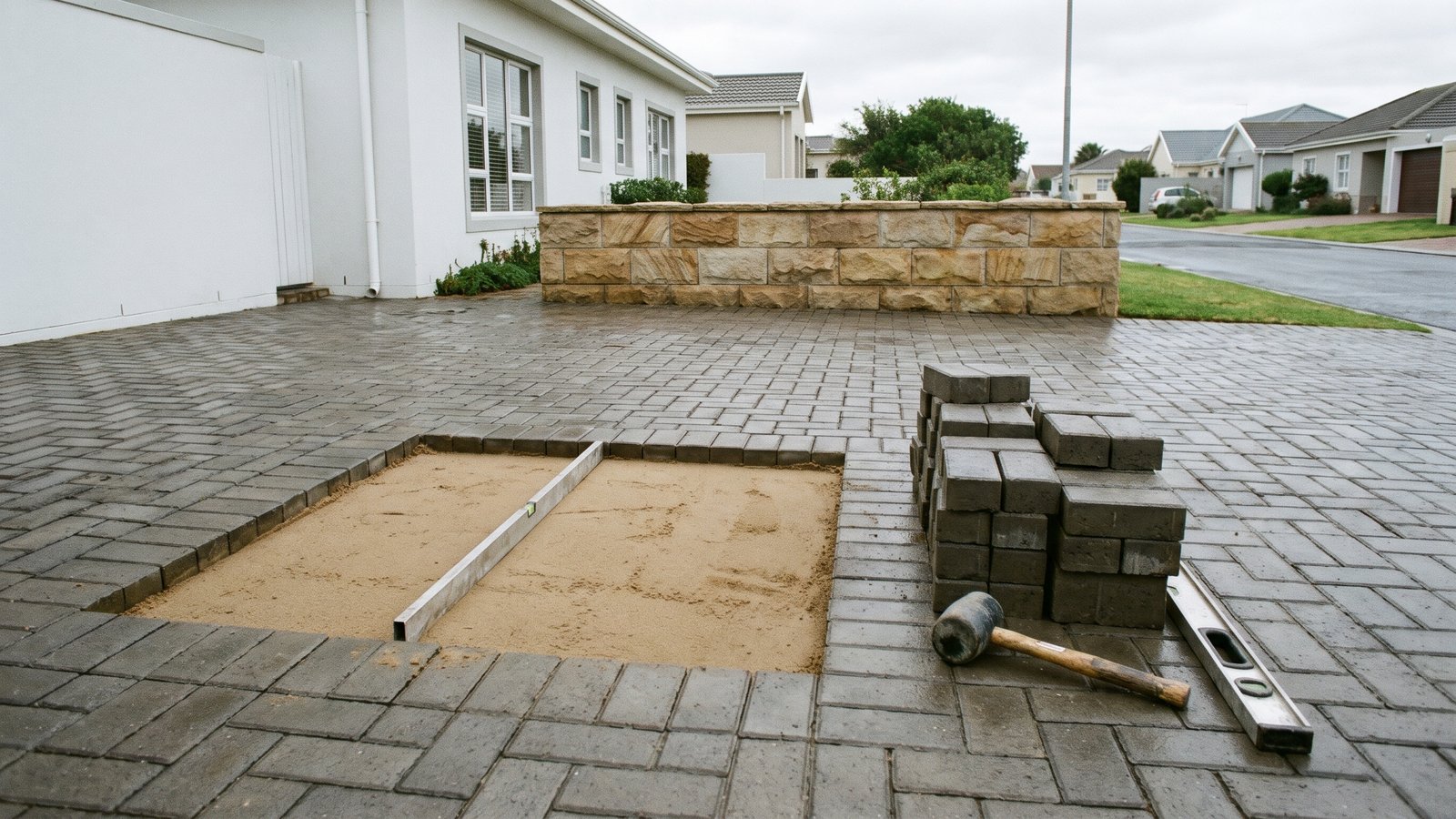
Paving repairs in Cape Town: we lift and re-lay sunken, loose and uneven pavers for R150 per m², across the Western Cape. A repair starts by identifying the cause of the movement. Replacement pavers, base correction under a re-lay and any other repair work are priced per job.
Re-lay or replace: how a paving repair is judged on site
Contents
Sunken, loose and uneven paving is normally re-laid with its own pavers, and damaged units are replaced. The call on site comes down to two questions: are the pavers themselves sound, and which layer under them gave way?
| What you see | Usual cause | Repair |
|---|---|---|
| A dip or hollow that holds water | Weak base or ground, water under the paving, overloading, or too much bedding sand | Lift the pavers, fix the cause, reinstate the level and re-lay |
| Pavers that rock or tilt when driven on | Joint sand lost to wind, rain or traffic | Re-sand the joints; re-lay where the pavers have tilted |
| Rows creeping outwards at the side | No edge restraint, or one that has failed | New edge restraint, then re-lay the loose rows |
| Chipped corners and edges | Joints laid too tight | Damaged pavers replaced and re-laid with a 3 mm gap |
| A sunken strip along a pipe or cable line | Trench backfill not rebuilt to the standard of the original earthworks | Rebuild the trench fill properly, then re-lay |
Replacing the whole surface is a different job, priced as new paving in the table at the end of this page.
What causes pavers to sink
Pavers sink when a layer underneath them gives way. The Concrete Manufacturers Association (CMA) names four causes of settlement in its block-paving design manual.
- A weak subbase or subgrade. The ground or the stone layer under the sand was not built or compacted for the load.
- Water under the paving. The CMA’s earthworks note adds that most pavement failures are due to water getting into the layers.
- Overloading. Heavier vehicles than the paving was built to carry.
- Bedding sand that is too thick. The manual warns against using bedding sand to fill hollows in the subbase, since the paving settles later.
Local ground plays a part. The City of Cape Town’s roads and stormwater standards warn that groundwater levels can change during the Cape Town winter, so ground that was dry when it was paved in summer can be wet months later. The City’s Blaauwberg district plan notes that the low-lying, shell-rich soils near the ocean frequently become waterlogged because of high local water tables.
Service trenches are another cause. The CMA’s earthworks note says trenches are often backfilled by the contractor laying the pipes, who does not know the earthworks design, and that this often results in local collapse of the paving.
Fixing sunken pavers
A sunken area is fixed from the bottom up. The CMA’s design manual sums up the repair: the area is lifted, the problem is addressed, the level is reinstated and the pavers are re-laid.
- Lift the pavers. Jointing sand is cleared from around a paver and it is levered out with two screwdrivers, as in the CMA’s reinstatement method.
- Fix the layer that failed. What is done here depends on the cause found: a weak base, water, overloading or deep sand.
- Re-screed the sand. Bedding sand goes back at 25 mm. It is not thickened to fill a dip in the base, which the CMA warns leads to settlement later.
- Re-lay and compact. The pavers go back in their pattern and are bedded with at least two passes of a plate compactor.
- Fill the joints. Sand is broomed into the joints and compacted, and this is repeated until the joints stay full.
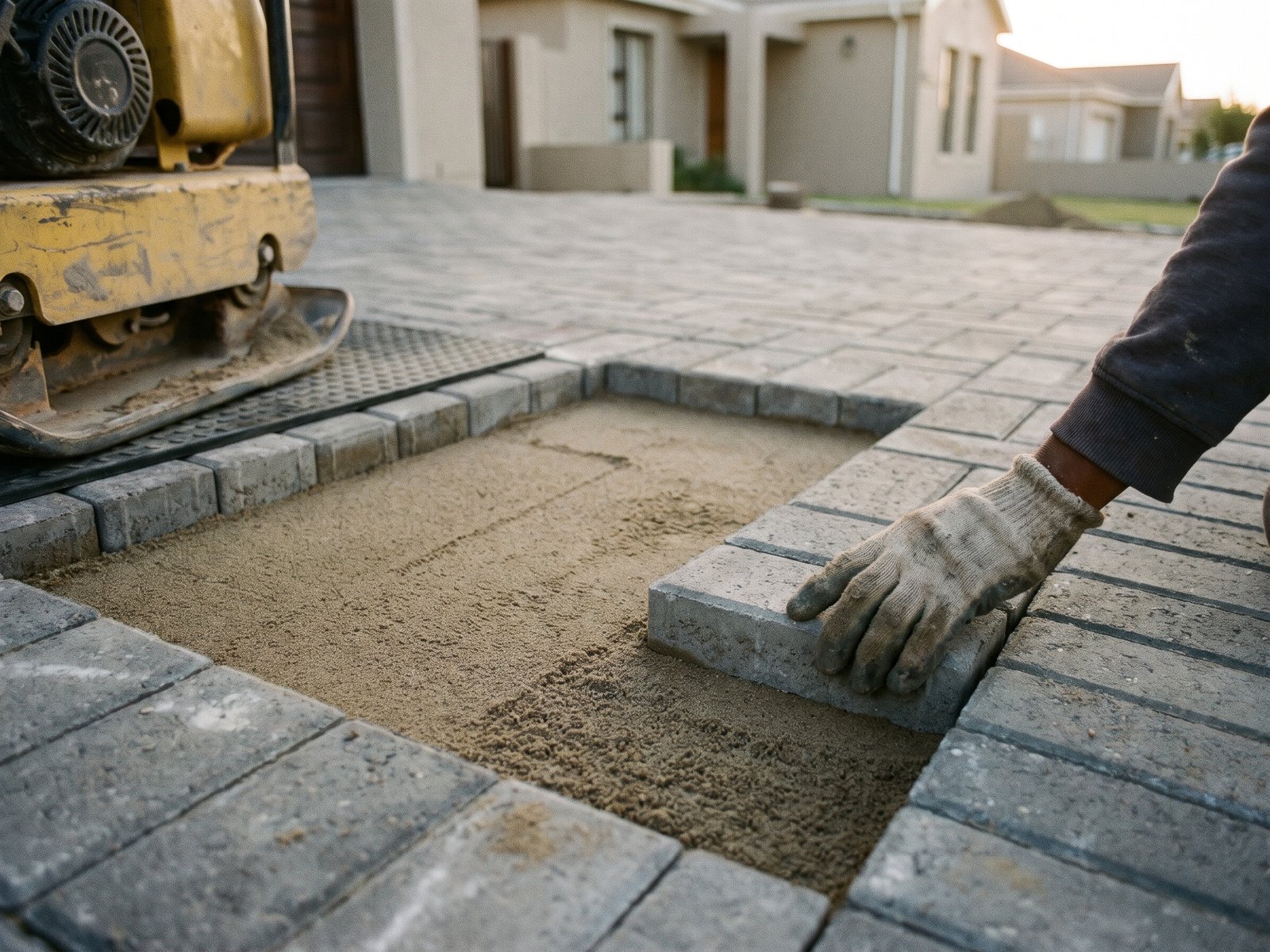
A sunken strip over a service trench has its own method in the CMA’s laying manual. The trench is backfilled and the soil compacted to at least the same density as the surrounding soil, and the pavers on either side are lifted a further 300 mm so the bedding sand there can be loosened and re-screeded before re-laying.
Next to a drain or channel, the repaired paving should finish 5 to 10 mm higher than the drain, as the CMA specifies.
Loose and moving pavers
Pavers move when they lose the sand in their joints or the edge that holds them in. The CMA’s laying manual notes that wind, rain and traffic remove joint sand early on, and that pavers short of joint sand tilt under traffic and spall.
Kerbs are essential to stop paving spreading and losing interlock, according to the CMA’s step-by-step guide. Edge restraints hold the pavers in position and prevent horizontal creep, the CMA notes.
- Where lost joint sand is the cause, rocking pavers need their joints re-sanded and compacted. Pavers that have already tilted are lifted and re-laid.
- Where the edge has failed, the loose side rows need a proper edge restraint before they are re-laid.
Uneven pavers and getting them level
Uneven paving is levelled the same way sunken paving is fixed: the pavers come up, the layer that moved is corrected, and the level is reinstated before they are re-laid. Adjusting the sand under a single paver is how the CMA’s step-by-step guide corrects a high or low paver while new paving is being laid.
Level does not mean dead flat. The CMA’s earthworks note says a minimum fall of 2% in any direction is generally required, and that the paving needs no undulations, so water runs off instead of ponding.
Tree roots damage paving from below. For roundabout landscaping, the City of Cape Town’s road guidelines recommend 1.5 m between the road edge and the side of a mature tree trunk unless root barriers are installed, because of the damage roots do to the road pavement structure. Ask what will stop the root coming back before you pay for a re-lay next to a tree.
Chipping and crumbling pavers
Pavers chip at the edges when their joints are too tight, and pavers that crumble are replaced rather than re-laid.
The CMA’s laying manual allows an optimum space of 3 mm between blocks, and says a space that is too small leads to spalling, damage to the blocks and reduced load transfer. Spalling is the trade word for flaking edges and corners. Pavers with a chamfer, the small bevel on the top edge, are less prone to it: the CMA’s guide says chamfers reduce chipping and spalling.
The CMA’s laying manual says damaged blocks must be removed and replaced. Strength matters where heavy vehicles drive. The CMA’s technical note says SANS 1058:2021 grades concrete pavers by tensile splitting strength, and that class 30/2.0 is not recommended for heavy traffic.
Efflorescence, a whitish deposit on the surface, is not damage. The CMA’s design manual describes it as purely superficial, with no effect on the durability or strength of concrete paving units.
What a paving repair costs: R150 per m² to lift and re-lay
Lifting and re-laying existing paving costs R150 per m². Other repair work is priced per job.
| Job | Price |
|---|---|
| Lift and re-lay existing paving | R150 per m² |
| New half paving, all-in | R230 per m² |
| New cement bond paving, all-in | R320 per m² |
| Replacement pavers, new edging and other repair work | Priced per job |
The all-in rate for new paving covers ground preparation, paving materials and their delivery, laying, grouting and rubble removal. For new paving, see our paving prices in Cape Town and our driveway paving page.
Before you accept a repair quote, check these points.
- The quote names the cause underneath as well as the area to be lifted.
- Joint sand is swept in and then vibrated in with a plate compactor.
- Water runs off the repaired area instead of collecting in it.
To book a repair, call 081 408 9946.