
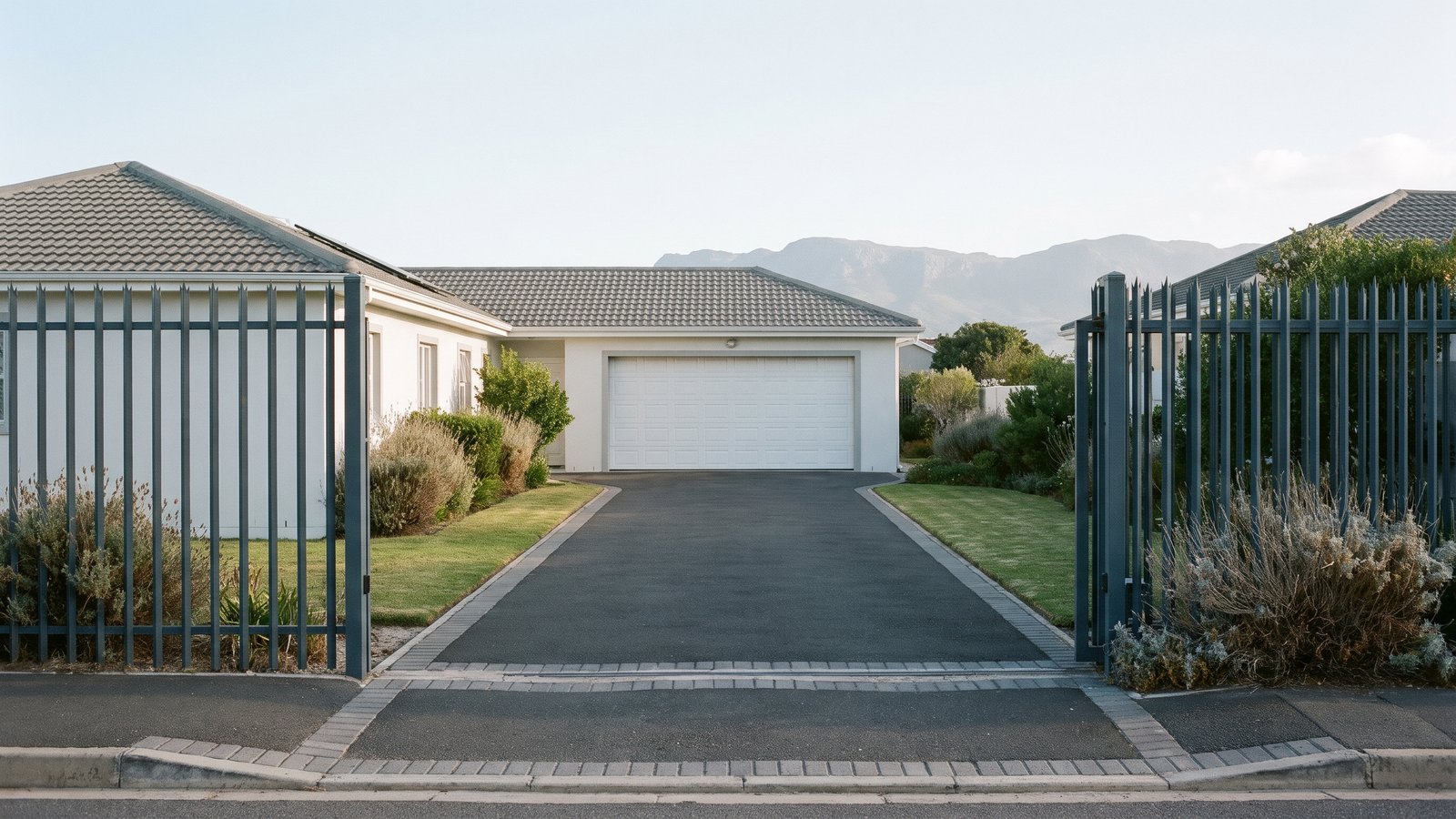
Tar surfacing in Cape Town: we lay tar and asphalt driveways across the Western Cape, priced per job. A written tar quote should list the size of the area, the base work the ground needs, and how the edges and drainage are finished.
What a tar driveway is made of
Contents
The bitumen industry body Sabita treats asphalt and chip seals as two different surfacings. It defines asphalt as a mixture of aggregate, mineral filler and bituminous binder. It defines a chip seal, or spray seal, as one or more sprays of bituminous material onto the surface with a cover of stone aggregate. Its definition of a bituminous binder excludes coal tar, so neither surface is coal tar.
Sabita’s guideline for residential streets says thin asphalt gives a superior ride and a more even surface than a chip seal, and a more durable one, in many cases lasting 20 to 30 years on those streets. Ask which of the two a quote is for.
How tar surfacing is laid
Hot asphalt goes down last, on top of a prepared base. The steps below follow Sabita’s manuals on hot-mix asphalt for residential streets and for paving in adverse weather.
- Set the falls. Sabita asks for a base that drains well, with a fall of at least 1% in a direction that takes water off the surface.
- Build and compact the base. Sabita calls pavement support essential for a sound platform on which the asphalt can be compacted.
- Prime the base. A properly applied, well cured prime coat gives the base temporary protection from rain.
- Tack coat. Sabita recommends a tack coat under every asphalt wearing course, even on a fresh prime, to make the asphalt stick.
- Lay the asphalt hot. With 60/70 penetration-grade bitumen, Sabita’s figures have the asphalt coming out behind the paving machine at about 140 °C.
- Roll it straight away. Rolling has to happen while the mat is still hot. For thin layers Sabita recommends a vibrating roller set to high frequency and low amplitude, because it reaches density in fewer passes than a static roller.
- Keep handwork to a minimum. Hand-laid asphalt cools fast. Sabita’s guideline says paving should be organised to minimise handwork, and that any handwork should be done at the hottest time of the day with fresh, hot asphalt from a truck.
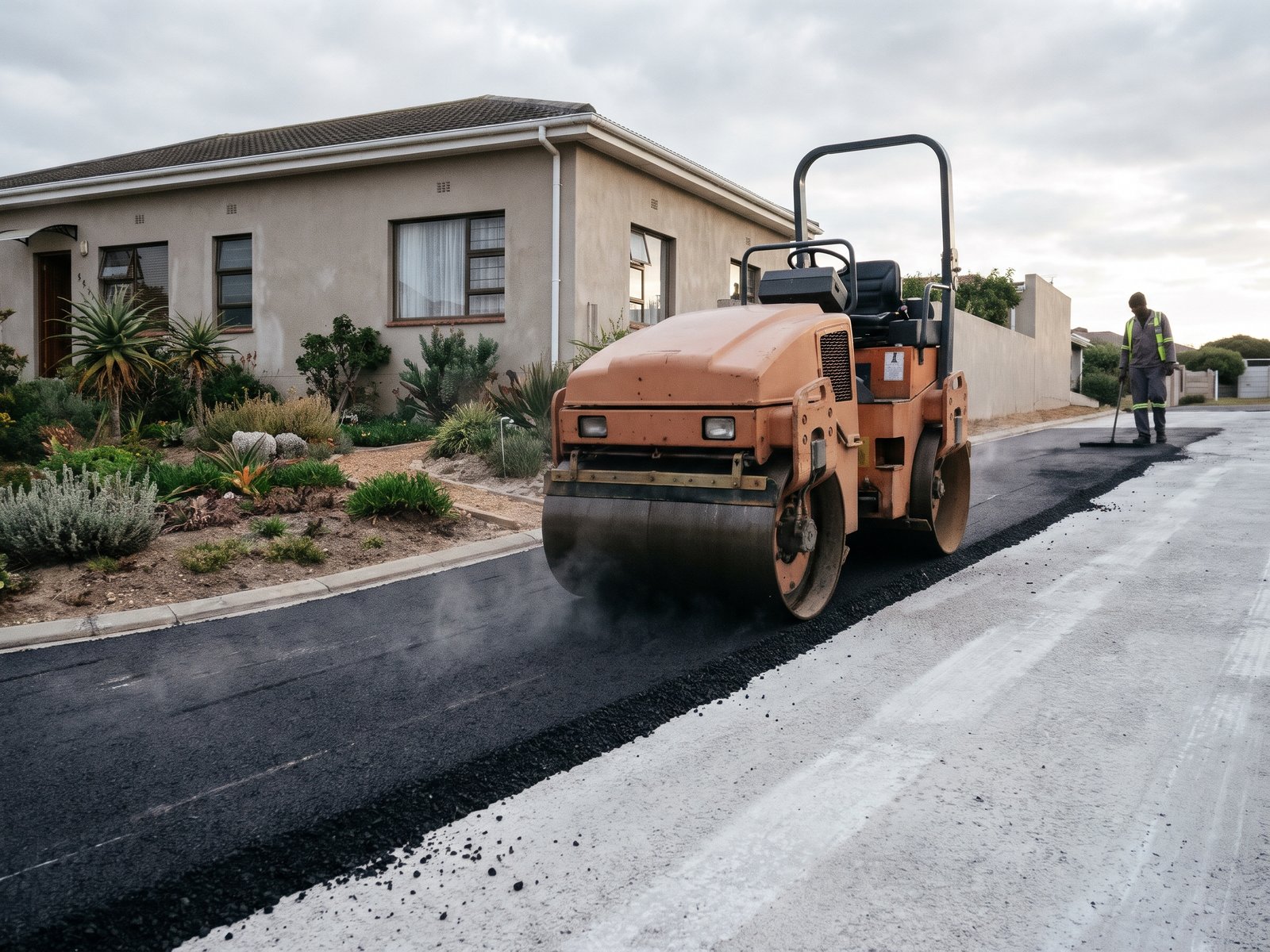
A thin asphalt layer leaves some of the unevenness underneath. As a rough guide, Sabita says a thin, machine-laid layer reduces the unevenness of the surface under it by about 50%. Where ride quality is a priority and the unevenness is excessive, it recommends levelling layers before the final layer.
Cape Town weather and tar
Rain, wind and low temperatures make tar harder to lay well, because they cool the asphalt and shrink the time left to compact it. The City of Cape Town’s Tygerberg district plan places that district in the winter rainfall region of the Western Cape. Sabita wrote its adverse-weather manual with those conditions in mind: rain, wind and low temperatures in winter rainfall areas.
Sabita’s manual names three risks: rapid cooling, a wet base and trapped water.
- Rapid cooling. Sabita says cold and wind cool the asphalt far more than rain alone.
- A wet base. Moisture in a granular base introduces weaknesses that make proper compaction hard to achieve.
- Trapped water. Water caught in the asphalt can cause a loss in durability.
Bitumen hardens as it oxidises, and Sabita’s binder manual says poor compaction of asphalt speeds that hardening up, especially in warmer climates.
Tar or paving for a Cape Town driveway
We lay both, so the choice can follow the site. Tar gives a continuous surface, and concrete block paving gives individual pavers that can be lifted.
| Tar (asphalt) | Concrete block paving | |
|---|---|---|
| Price | Priced per job | R230 per m² half paving or R320 per m² cement bond, all-in |
| Surface | A continuous surfacing | Individual pavers with sand-filled joints |
| Oil and fuel | The CMA says spilt oil and lubricants soften asphalt | The CMA lists no damage from petroleum products |
| Opening a trench | The CMA says reinstatement in other paving materials leaves a scar | The CMA says pavers lifted for a trench can be re-laid so the repair is invisible |
The CMA is the Concrete Manufacturers Association, the body for concrete paving, so read its comparisons with that in mind. Sabita’s binder manual adds the main ageing point for tar: hardening from oxidation is irreversible and is the main cause of ageing of bitumen. In thin layers exposed to harsh conditions, it says, that hardening can make the surface brittle, leading to cracking, fretting and stone loss.
For paved driveways in brick, cobble or exposed aggregate, see driveway paving in Cape Town.
Tarring over the verge
The verge outside a property is part of the road reserve. The City of Cape Town’s RIM Wayleave Standards (version 4.0, September 2025) describe the road reserve as including the road, sidewalk and verge. In the same standards, building a new driveway crossing, altering an existing one and surfacing the road verge need no wayleave and form part of a Miscellaneous Permit instead, and no work may start without a signed permit.
Before you sign a tar quote that runs out to the kerb, ask whether the verge section is included and who applies for the permit.
Tar surfacing prices
Tar surfacing is priced per job. Our published rates are for paving: R230 per m² for half paving, R320 per m² for cement bond, and R150 per m² to lift and re-lay. For what each includes, see paving prices in Cape Town.
A tar quote you can compare should state these things.
- The area in square metres, measured on site.
- The base work: digging out, filling and compacting what the ground needs.
- Prime and tack coats under the asphalt.
- The edges, and what holds them in place.
- Falls and drainage, so water runs off and away from the house.
- The verge section, and the City permit for it.
To get a tar quote, call 081 408 9946.